
iPhone Duo vs Pro Max: Reading the New Battery Capacity Figures
The Pro Max has the larger battery capacity in the latest iPhone comparison. Apple's newly surfaced iPhone Duo figure is 4,883 mAh; the reported eSIM-only iPhone 18 Pro Max figure is 5,567 mAh. A buyer choosing between a folding screen and the larger Pro model now has a 684 mAh difference to consider.
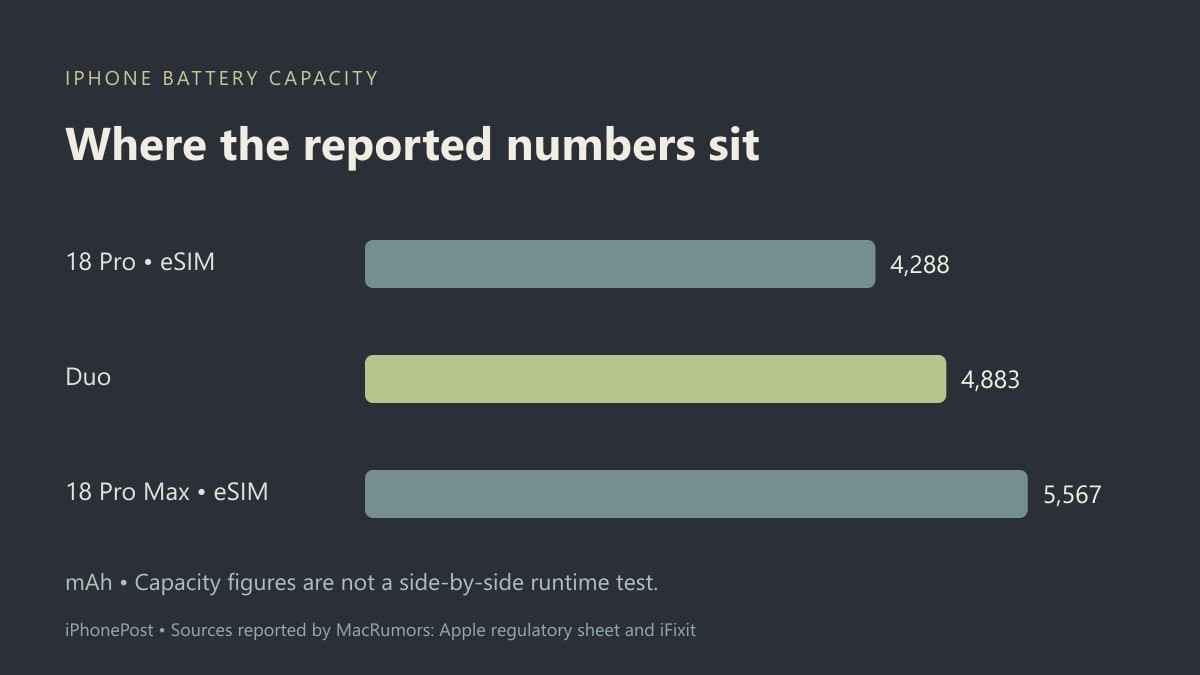
MacRumors highlighted the Duo specification on October 18, linking an Apple regulatory sheet published on Friday. The report cites iFixit for the Pro models' capacities. These are hardware figures, rather than results from a side-by-side endurance test.
Keep the regional model in the comparison
The reported capacities are 4,288 mAh for the eSIM-only iPhone 18 Pro, 4,883 mAh for Duo and 5,567 mAh for the eSIM-only Pro Max. Duo is therefore 595 mAh above the smaller Pro, as well as 684 mAh below the Max.
Using the eSIM-only Pro variants matters. A regional model with a physical SIM tray is not automatically the same hardware comparison. MacRumors says Duo has no physical-SIM version, so there is no alternate tray configuration to account for in its capacity figure.
The total is also consistent with the earlier reported pair of cells: 2,962 mAh and 1,921 mAh. Adding them gives 4,883 mAh. That supports the previously reported total; it does not replace a teardown showing the internal arrangement.
Choose a test that resembles the way you use a phone
For someone who spends most of a commute reading, the question is how long the chosen screen can do that task. For someone playing a game across the inner display, the task and display are different. The capacity gap cannot answer both questions in hours.
Before using a review's battery result to choose a model, look for these details:
- Whether Duo used its inner screen, outer screen or a stated mixture.
- Display brightness and whether the comparison used the same task.
- Wi-Fi or cellular conditions, plus the software version.
- Whether the result measures continuous use or a mixed day with idle time.
Apple's Duo announcement describes apps adapting between the two displays. That flexibility is part of the appeal, but also a reason a single undifferentiated runtime figure can be hard to apply.
The capacity comparison can inform a shortlist today. It cannot declare the winner of a test that has not been identified. If availability also affects the choice, our pickup report explains the separate uncertainty around store stock. Keep the delivery question beside the battery question, rather than letting either stand in for the other.